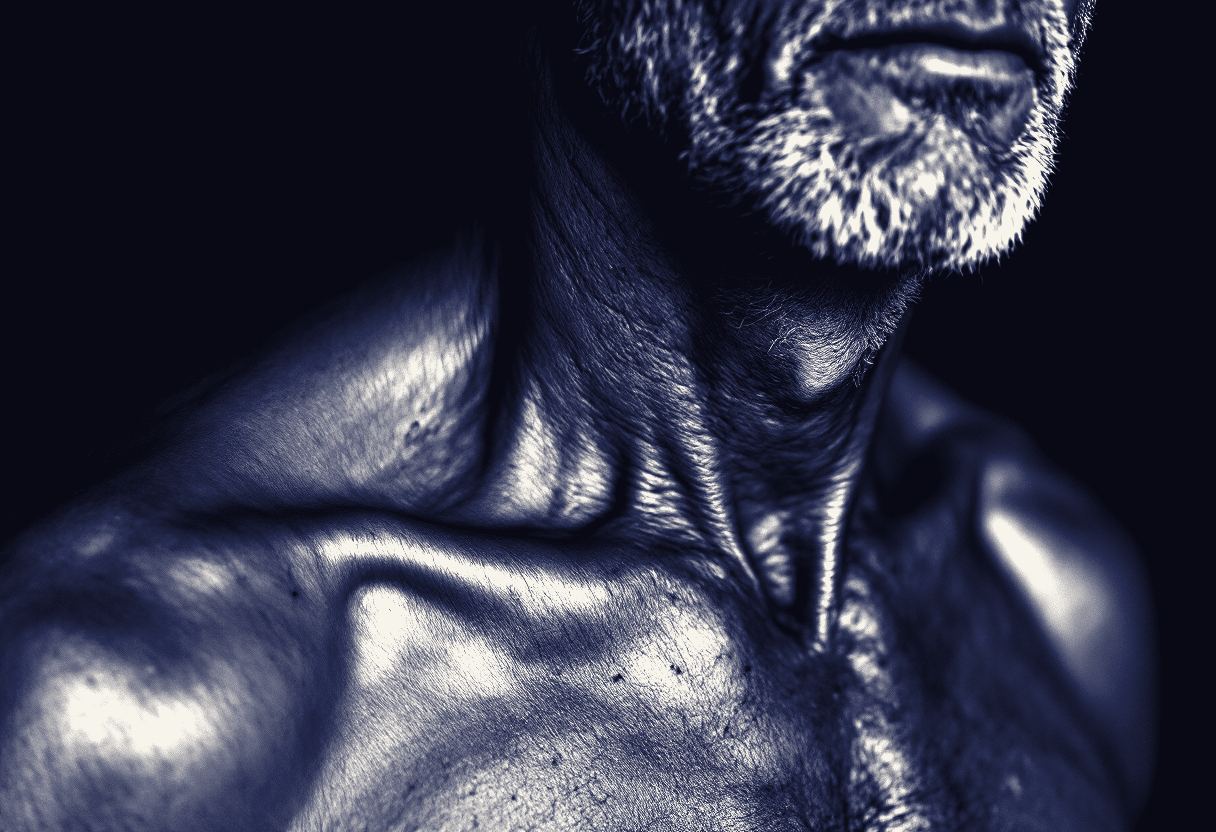
Men tend to describe ageing as something that happened suddenly. That perception is not entirely wrong, and the reason is structural. The male ageing curve has a different shape from the female one, and it produces exactly the experience of nothing changing for twenty years and then everything changing at once.
1. Two processes, not one
Skin ageing is the sum of two distinct processes that behave differently.
Intrinsic ageing is chronological. It proceeds regardless of behaviour: progressive reduction in collagen production, slower cell turnover, reduced fibroblast activity, thinning of the dermis and reduced barrier repair capacity. It affects sun protected skin, which is why the inner upper arm is the standard comparator.
Extrinsic ageing is environmental, and it is dominated by ultraviolet exposure. It produces coarse wrinkling, irregular pigmentation, telangiectasia, a leathery texture and loss of elasticity. Smoking is the second largest contributor. Extrinsic ageing accounts for the majority of what is visible on the face of a man in his sixties, which is why the comparison with his own inner arm is so striking.
The practical implication is that most facial ageing is not inevitable. It is accumulated. Detail in photoageing in men.
2. The shape of the male curve
Male skin starts thicker, with greater collagen density, so early fine lines take longer to appear. Collagen content then declines steadily with age. Because there is no equivalent to the sharper decline associated with the menopausal transition in women, the male trajectory is flatter for longer and does not show a single inflection point.
The consequence is a delayed but steeper perceived change. Structural loss accumulates below the threshold of visibility for years, then crosses it. Men typically report the change as beginning in the fifties, which is when accumulated loss becomes apparent rather than when it began.
3. The features that change
| Structure | What happens | How it presents in men |
|---|---|---|
| Dermal collagen and elastin | Progressive reduction and disorganisation | Loss of recoil, lines that persist at rest, thinner appearance of skin over the temples |
| Facial fat compartments | Redistribution and volume loss | Temple hollowing, flattening of the mid face, a heavier appearance around the jaw |
| Bone | Resorption at the orbital rim, maxilla and mandible | Reduced projection and support; a change that no topical product addresses |
| Muscle | Repeated contraction etching dynamic lines into static ones | Glabellar and forehead lines, more pronounced in men with stronger musculature |
| Sebaceous glands | Enlargement with age despite stable output | Visibly larger pores, particularly on the nose; sebaceous hyperplasia |
| Vasculature | Telangiectasia and background erythema | Persistent redness across cheeks and nose, often attributed to weather |
| Melanocytes | Uneven distribution and function | Lentigines on the face, hands, forearms and scalp; irregular tone |
| Hair | Androgenetic loss, coarsening of eyebrow, ear and nasal hair | Scalp exposure, which changes ultraviolet risk substantially |
4. What men actually notice, in order
Reported concerns cluster consistently: looking tired, which usually means periorbital hollowing and glabellar lines; the jawline losing definition; skin looking grey or dull, which often reflects photodamage and texture rather than pigment; and hair loss, which is a separate process considered in male pattern hair loss.
The gap between what men notice and what has actually changed is instructive. Looking tired is usually not about sleep. It is about volume, light reflection off an irregular surface, and lines that no longer relax. That distinction matters because it determines which family of treatment could plausibly help, as set out in the treatment landscape for men.
5. What is modifiable, ranked
- Ultraviolet exposure. By a wide margin the largest modifiable factor, and the one men address least.
- Smoking. Well established, dose related, and it affects the skin independently of sun.
- Topical retinoids. The topical intervention with the best evidence for photodamage, measured over months to years.
- Sleep, alcohol and general health. Real but modest, and easily overstated by marketing.
- Everything else in a bottle. Antioxidants, peptides and the rest occupy a spectrum from plausible to unevidenced, and none approaches the first three in effect size.
6. The scalp is part of this
Androgenetic hair loss exposes skin that has been protected for decades to direct ultraviolet radiation. The scalp then becomes one of the highest exposure sites on the body, and it is also one of the least examined. Actinic keratoses and skin cancers on the scalp are common in older men and frequently found late, which is a good reason to include the scalp in both sun protection and self examination. See skin cancer in men.
7. A realistic account of what treatment does
Interventions divide by what they can reach. Neuromodulators address lines caused by movement. Fillers and biostimulators address volume and structure. Resurfacing addresses surface quality, pigment and texture. Nothing addresses bone. Nothing reverses accumulated elastosis completely. And no combination returns a face to a previous decade, whatever the imagery in the advertising implies.
What is achievable is meaningful and worth stating plainly: better surface quality, softer dynamic lines, some restoration of structural support, and, above all, a slower future trajectory if ultraviolet exposure is controlled from now. The last of those is free, and it is the one most consistently declined.
8. Smoking, which deserves its own paragraph
After ultraviolet exposure, smoking is the best established environmental contributor to visible skin ageing, and the effect is dose related and largely independent of sun exposure. The mechanisms described include reduced dermal blood supply, degradation of collagen and elastin, and impaired wound healing.
The visible pattern is recognisable: a greyish, dull tone, deeper and more numerous lines at the upper lip and around the eyes, and a coarser skin texture, appearing earlier than would be expected for the person's age. In men who both smoke and have significant outdoor exposure, the two effects compound.
The relevant point for this publication is not moral. It is that a man considering paying for treatment of facial ageing while continuing to smoke is buying against a headwind, and the return on stopping exceeds the return on any procedure discussed on this site. The same is true of continuing ultraviolet exposure, and for the same reason: both keep adding damage faster than treatment removes it.